

Mind the messaging gap: What hero section tests taught us about how people read email
Most brands only talk about themselves or only talk about their customers. Ethan Alston Norville shows why you need both, and what your hero section is actually doing to people's brains.

How many of you have brands or emails that you actively seek out and want to read? Go ahead, raise your hand.
Now: how many of you have a inbox full of emails you never open and probably never will?
Ethan Alston Norville opened his Unspam 2026 session in Long Beach with exactly that contrast. Both things are true at the same time for almost everyone in the room. We all know which emails we protect. We all know which ones we avoid. And most of us, if we are being honest, are sending the second kind.
Norville, Email Marketing Manager at the American Kennel Club, describes his job as translation: taking what a brand wants to say and turning it into something people actually care about. His goal has always been to send email that works and that the person on the other end is genuinely happy to receive. Not one or the other. Both.
His session had two halves. The first was about hero sections and what they are actually doing every time someone opens your email. The second was about the messaging gap, the structural reason most brands send the kind of email nobody opens. Here is what he covered, and what to do about it.
Hero sections: the most valuable real estate you are probably misusing
A hero section is the first thing a subscriber sees after they open your email. You already knew that. But Norville's point was not definitional. It was about what happens in the brain in the roughly zero seconds between opening and deciding.
Before anyone reads a single word of copy, they already feel something. That reaction is instant. Emotional, not rational. And it is entirely shaped by what is in that top section.
Think about an image of a steaming cup of coffee. If you are a coffee drinker, you might have a Pavlovian reaction before you process a single word. Hungry. Curious. Indulgent. Urgent. The emotion lands first. The copy lands second. The hero section's job is to make sure that first hit is the right one.
That is the hero section's actual job. Not to inform. To set the tone.
At AKC, the team builds breed-personalized email marketing at scale. Registration series, lifestyle content, lifecycle flows for new dog owners. Two examples Norville walked through were from the same registration sequence: the first email in the flow and the third. The first said "register today."
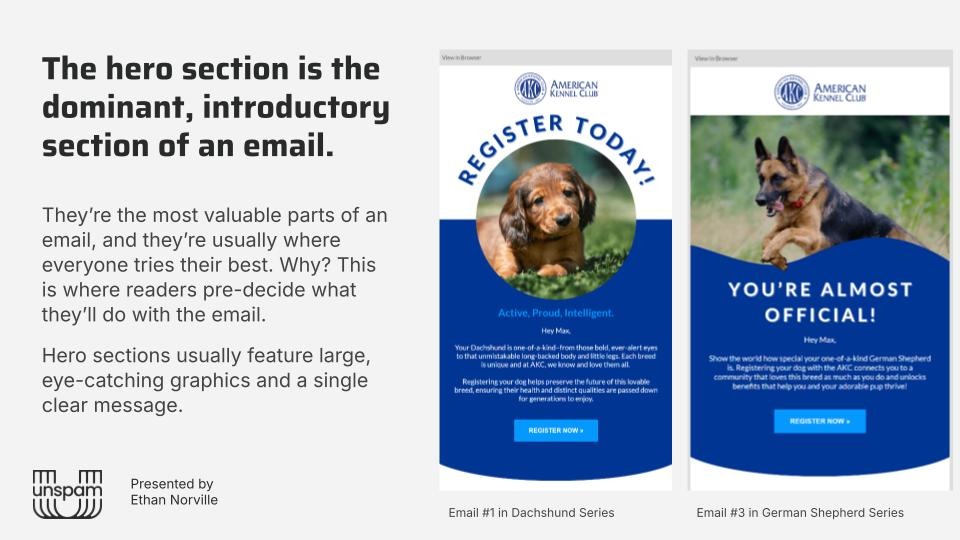
The third said something closer to "you are almost there." Both used live text headlines. Both used breed-specific imagery. Both were designed around one thing: reducing the mental cost of the next action.
That word, "almost," does something specific. It tells the subscriber they already started. It removes the possibility of thinking they have to begin again. It compresses the perceived distance to completion. Those are the micro-decisions people are making subconsciously every time they open one of your emails.
The clarity problem
Any ambiguity in the hero section creates friction. Not the kind subscribers notice or complain about. The invisible kind: they click, land on a page, feel slightly unsure, and leave without converting. You see the click. You never see why the conversion did not happen. And that distinction matters: click-through is not the same as post-click conversion, and the hero section is often what determines which one you get.
Norville's numbers: ten to forty percent differences in click-through and post-click conversion rates, based solely on hero section changes. Forty-five percent average click-through rate lifts across tests run across multiple organizations. Those are not small numbers. And they came from changes most people would describe as "minor copy tweaks."
A note on live text
One structural choice AKC makes consistently: live text in hero headlines, not text embedded in images. The reason is obvious but worth saying out loud. Images do not always load. Thanks, Outlook. If your most important message is a JPG, a meaningful share of your audience is looking at nothing where your value proposition should be. Live text loads regardless.
It is also better for accessibility. Norville flagged this explicitly. (The room responded accordingly. Woo.)
The billing failure edge case
Norville posed a useful hypothetical. Billing failure emails do not usually have hero sections. Would adding one make them better? Warmer? More on-brand?
He built the answer himself: no.
Some emails are not trying to evoke anything. They are trying to get someone to update a card number with as little friction and as little overthinking as possible. You do not want the subscriber to feel anything about the experience. You want them to see "card expired," fix it, and move on without even noticing what they were paying. They had the benefits. The experience was fine. You want that to continue uninterrupted.
That is what Norville called an interruption-free experience. The goal is to get someone back to the status quo as quietly as possible. A hero section that adds warmth or brand personality to that moment is solving a problem nobody had.
In those cases, the absence of a hero section is a design decision. The quietness is intentional. The emotion you are going for is no emotion at all.
The principle: match the emotional register to the action you need. Sometimes that is inspiration. Sometimes it is urgency. Sometimes it is calm, dry nothing.
The messaging gap: why brands lose subscribers without knowing it
The second half of Norville's session shifted from design to strategy. And this is where Unspam 2026 attendees got something most email marketing talks skip entirely: a framework for why so many programs quietly fail, and what the ones that do not have in common.
The messaging gap is the distance between what a subscriber wants to receive from a brand and what the brand actually sends. Most programs are living in that gap constantly. They send what they think the buyer should care about. Not what the buyer is actually looking for.
Most emails spark no emotion at all. Or worse, they spark the wrong ones. Brands often do not realize it because they are sending what they think matters. What they miss is that they are a small part of their subscriber's very full life. The subscriber goes outside. They do things. And when a brand starts to understand the role it actually plays, the reception in the inbox looks completely different.
Before he got into the structural fix, Norville asked the room: does anyone think there is a way to consistently spark the right emotions at scale?
Almost no hands went up. Good news, he said. There is.
The four emotions every brand should be sparking
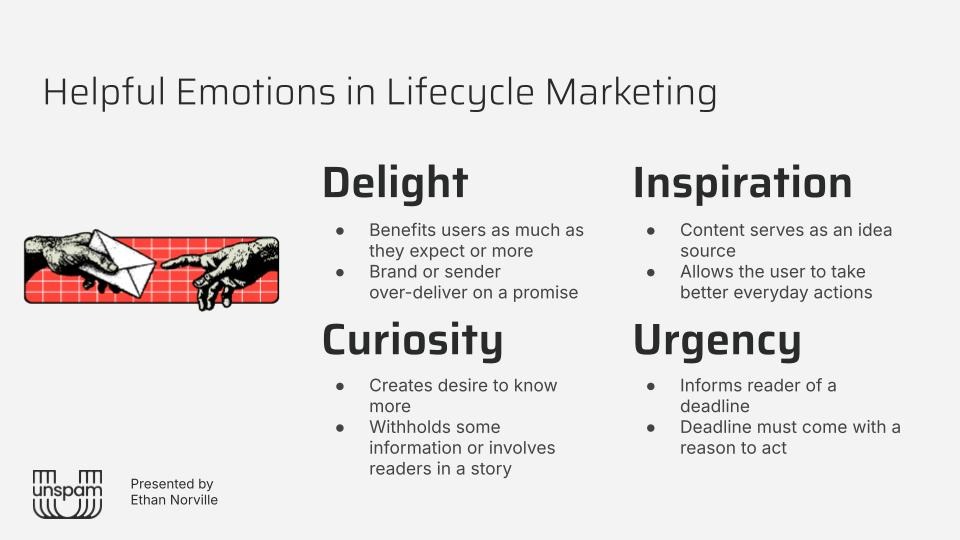
High-performing email programs reliably produce four emotions. Most programs produce none of them. The four are delight, inspiration, curiosity, and urgency. Delight is straightforward: people are pleasantly surprised, or consistently satisfied enough that opening your email feels like a small reward rather than a chore. Inspiration is when you give people good ideas for their actual lives, events, methods, things to try. You are not selling. You are contributing something useful to someone's week.
The other two need more care. Curiosity is the trickiest to calibrate. You spark it by teaching someone something small and leaving enough unsaid that they want to go find the rest. Give too little and nothing lands. Give too much and there is nothing left to be curious about. The sweet spot is a smallish insight that opens a door rather than walking through it for them.
Urgency is what most brands reach for first, and most brands use it wrong. One-day-only sales, countdown timers, eleven fifty-five PM deadlines. Urgency works when it has two parts: value, and a deadline to act on it. Without the value, the deadline is just pressure. With it, it is a reason to move.
If a brand can spark all four consistently, they are in a good spot. Most emails, unfortunately, spark none of them. And that slow accumulation of irrelevance is why consumers are not opening most of what lands in their inbox. They already know what to expect.
Two perspectives, one inbox
The structural reason most programs miss is simpler than it sounds. Every email a brand sends is essentially operating from one of two perspectives.
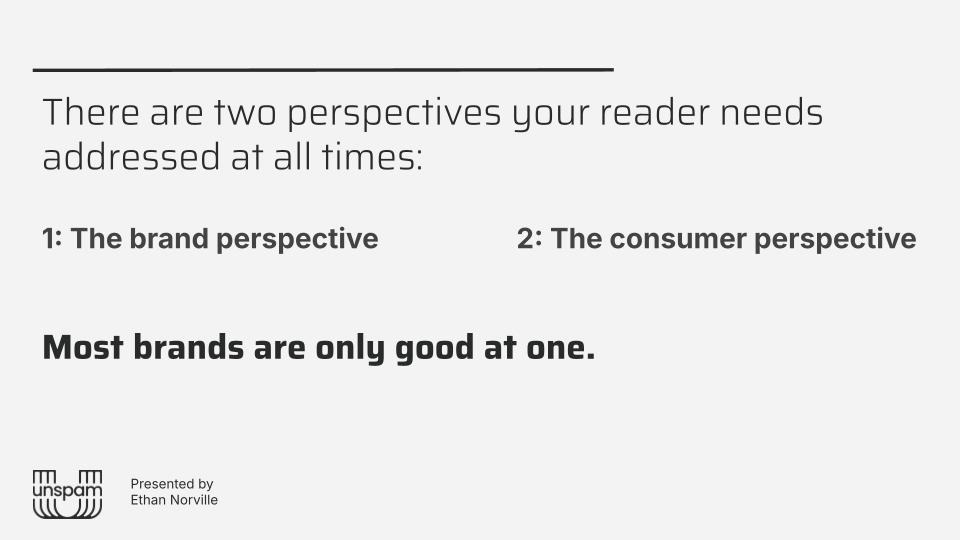
Consumer perspective emails demonstrate that you understand your subscriber. They solve something real. They offer something useful for the subscriber's actual life: where an order is, what to do with a product, ideas for this week, how to get started. These are the emails that make someone feel seen.
Brand perspective emails help subscribers understand you. Behind-the-scenes content, how a product is made, what the brand stands for, proof that what someone bought is worth having. Reviews, process walkthroughs, the philosophy behind a product decision. These are the emails that build belief.
To make the point concrete, Norville asked the room a quick show of hands. Would it be weird to buy something from a brand and get an order confirmation, but never hear anything about who they are or why the product is worth having? Maybe a little. Now flip it: what if a brand tells you everything about themselves and their products, and then you buy something, and you never get an order confirmation, no proof they know you exist? Also weird. Both extremes break something.
Most brands default to one and ignore the other. Some over-index on consumer perspective and never make a case for why they are worth buying from. Others talk about themselves constantly and never make the subscriber feel seen. Neither builds the kind of relationship that generates repeat purchases, word of mouth, or subscribers who reply to ask why their email did not arrive today.
That last one was not hypothetical. Norville has seen it happen. It is, he suggested, the actual goal.
The Monos example
To illustrate brand perspective done right, Norville pointed to Monos, the luggage brand. Their breakthrough ad campaign was not a lifestyle shoot. It was footage of their suitcases being thrown around a warehouse. The point was not "look at our aesthetic." It was "watch what we actually do to make this product worth your money."
You are seeing their process. You are buying into it. Buyer's remorse does not really have room to develop when the brand has already shown you the work.
And it does not have to live in a dedicated campaign. An order confirmation that includes a short section on what the brand did to make that specific product worth buying is not bloated. It is doing two jobs at once. It confirms the purchase and removes doubt in the same scroll.
Saying what you know vs. using what you know
Norville made a distinction here that is easy to miss.
A lot of brands think they are being personal when they reference what they know about a subscriber. "We see you're in LA. Hi, come buy from us." "We saw you shopping. Here's a gift." That is not personalization. That is a reminder that you have data.
Using the fact that someone is in LA to surface a nearby event, or using browsing behavior to answer a question they clearly had: that is personalization. The difference is whether the information is deployed for the subscriber's benefit or for the brand's.
When brands make that shift, subscribers start to not mind that the data exists at all. The resistance drops. Open rates go up. Click rates go up. The relationship starts to feel less like a brand talking at someone and more like a brand that has been paying attention.
What to take from this
Hero sections are not a design feature. They are the moment where someone decides how to feel about the rest of your email. Get the emotional register wrong and people click but do not convert. Get it right and you can move the needle by double digits without touching anything else. Focus on clarity, use live text, and match the emotion you are setting to the action you are asking for.
The messaging gap is not a tone problem. It is structural. If your email marketing program never sparks delight, curiosity, or inspiration, if it only ever creates urgency or says nothing at all, subscribers quietly put you in the pile they mean to unsubscribe from someday. Not because they dislike you. Because you have not given them a reason to build a habit around you.
Balance consumer perspective with brand perspective. Use data to deliver value, not just to reference it. Teach something small. Leave something to be curious about.
The brands that do this consistently are the ones subscribers start to protect. They stop unsubscribing. They start replying. They notice when an email does not arrive.
That is not a loyalty program. That is just email done right.
Articles to wet your whistle


.png)
Subscribe to our newsletter.
Dive into the world of unmatched copywriting mastery, handpicked articles, and insider tips & tricks that elevate your writing game. Subscribe now for your weekly dose of inspiration and expertise.